From Question to Answer: How Generative AI is turning Search into Storytelling
The demise of traditional search engines like Google, Yahoo, and Bing is inevitable. Why? Because keyword searches are not intuitive — but asking questions is.


From an early age we learn to quiz our most trusted advisors (parents, teachers, and friends) for the answers to life’s great conundrums.
What may start as “Why can’t I eat ice cream for breakfast?”, evolves into “Where’s the best coffee near me?” or “Which phone should I buy?” and, in the blink of an eye, our most trusted advisor has become the internet.
We’re so accustomed to asking questions that consulting an online oracle is far more natural than typing in a string of keywords.
From keyword to conversation
Large Language Models (LLMs) like ChatGPT, Gemini, and Claude respond to our queries conversationally — delivering clear, persuasive answers in a matter of seconds. Instead of expecting us to sift through endless links containing key terms, AI trawls the internet on our behalf and crafts a coherent, human-like response.
“Now our technology has acquired the ability to use language... you feel like the technology and the product that you’re interacting with understands you.”
– Aidan Gomez, CEO and Cofounder, Cohere
Behavioural shifts
There’s been a sharp rise in users turning to AI assistants for personal tasks with OpenAI’s own data showing people now seek help on everything from recipes and travel plans to major purchasing decisions and fitness regimes.
For users, these exchanges feel wonderfully intuitive. For businesses — especially those reliant on Search Engine Optimisation (SEO) — this shift is seismic. When visibility no longer depends on search rankings, but on whether a brand is even referenced in AI generated responses, it is fast becoming a struggle to get noticed at all.
Search: the slow decline
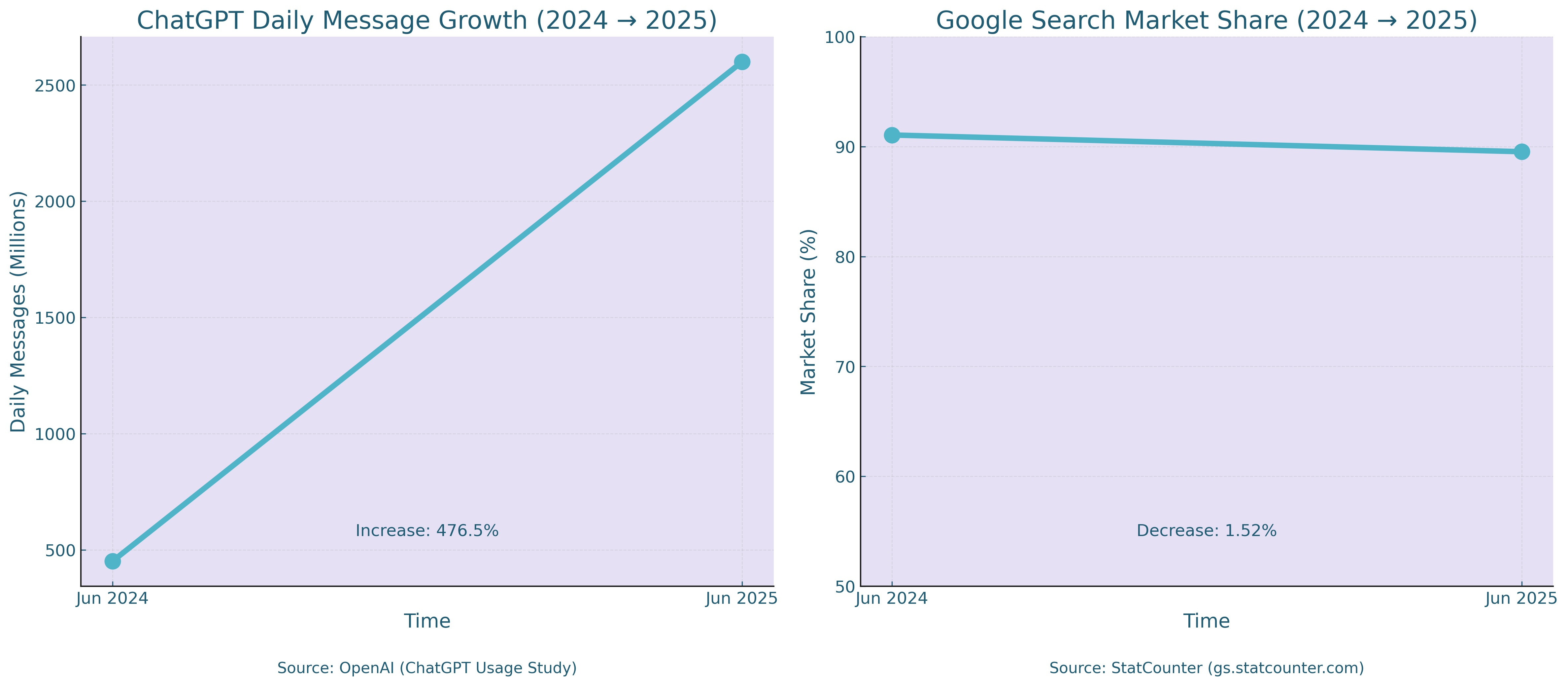
ChatGPT’s usage grew fivefold in the past year, with daily messages soaring from 451 million in June 2024 to 2.6 billion in June 2025.
Over the same period, Google’s share of the search engine market fell by 1.52%, according to the web analytics service, Statcounter.
Quick to respond to the development of AI models, Google fast-tracked its own LLM, Gemini, which now provides AI-generated summaries at the top of search results. Convenient for users — devastating for the SEO industry, because it is so incredibly efficient that users have almost stopped bothering to click through to original sources and websites.
Websites once reliant on search rankings have seen web traffic plummet as a result of the AI overviews that appear at the top of Google search results. DMG Media, owner of the MailOnline, claims AI summaries are responsible for a drop of up to 89% in click-through-rates to its own online news sites.
“It’s on an exponential curve, and we’re on the steep part of that curve right now.”
– Dario Amodei, CEO & Co-Founder, Anthropic
From mechanical visibility to narrative trust
In yesterday’s world, the rules of the game were very clear. Visibility was mechanical — built on keywords, backlinks, and metadata. In tomorrow’s world, visibility depends on whether generative systems trust a brand’s story enough to amplify it.
The good news is that it is entirely possible to build the requisite level of trust needed to get noticed through thought leadership and consistent engagement.
Whereas it was once possible to cheat the system and work your way into Google’s top ten hits through search engine optimisation, authority must now be earned using structured data, factual integrity, and a coherent narrative.
Going forwards, the brands that thrive will be those whose stories are told well enough to be retold by machines because those are the ones that will be read by customers and clients.

The new rules of visibility
In the age of AI, credibility depends, as much on machine legibility, as on human resonance. The most influential voices blend human expertise with algorithmic clarity — shaping narratives that AI recognises as authoritative, transparent, and distinctive into prose that is clear, digestible, and succinct.
Authority beats keyword density.
Structure beats backlinks.
Transparent sourcing beats metadata.
For communicators, policymakers, and corporate strategists, narrative integrity is the new competitive advantage.
The storyteller’s mandate
As strategy meets storytelling, our new task as strategic communicators is clear: build stories that travel not only across human audiences, but through the neural pathways of AI itself. For businesses, governments, and leaders, owning that narrative is the ultimate challenge.
Staying visible in the age of AI means turning expertise into stories that people — and machines — can trust. At Aurora Global Advisory, we blend strategic communications, media insight, and AI literacy to help leaders craft stories that resonate with people and register with machines.
In a world where discovery begins with a question, those who thrive will be those who answer with clarity.
I love your tagline, “Crafting stories that resonate with people and register with machines.” My question is this: how does an organization—or an individual—still earn clicks if readers feel satisfied with the AI-generated answer? I sometimes follow the links to confirm what AI gives me, but when I’m in a hurry and not looking to learn something new, I simply move on. How do creators navigate that shift? (Found you in Ana’s chat.)
Hey! Thought I’d let you know I just found you on Ana’s page.
xoxox
MM
I enjoyed this!!!
My latest post connects https://substack.com/@magickmica/p-180423717